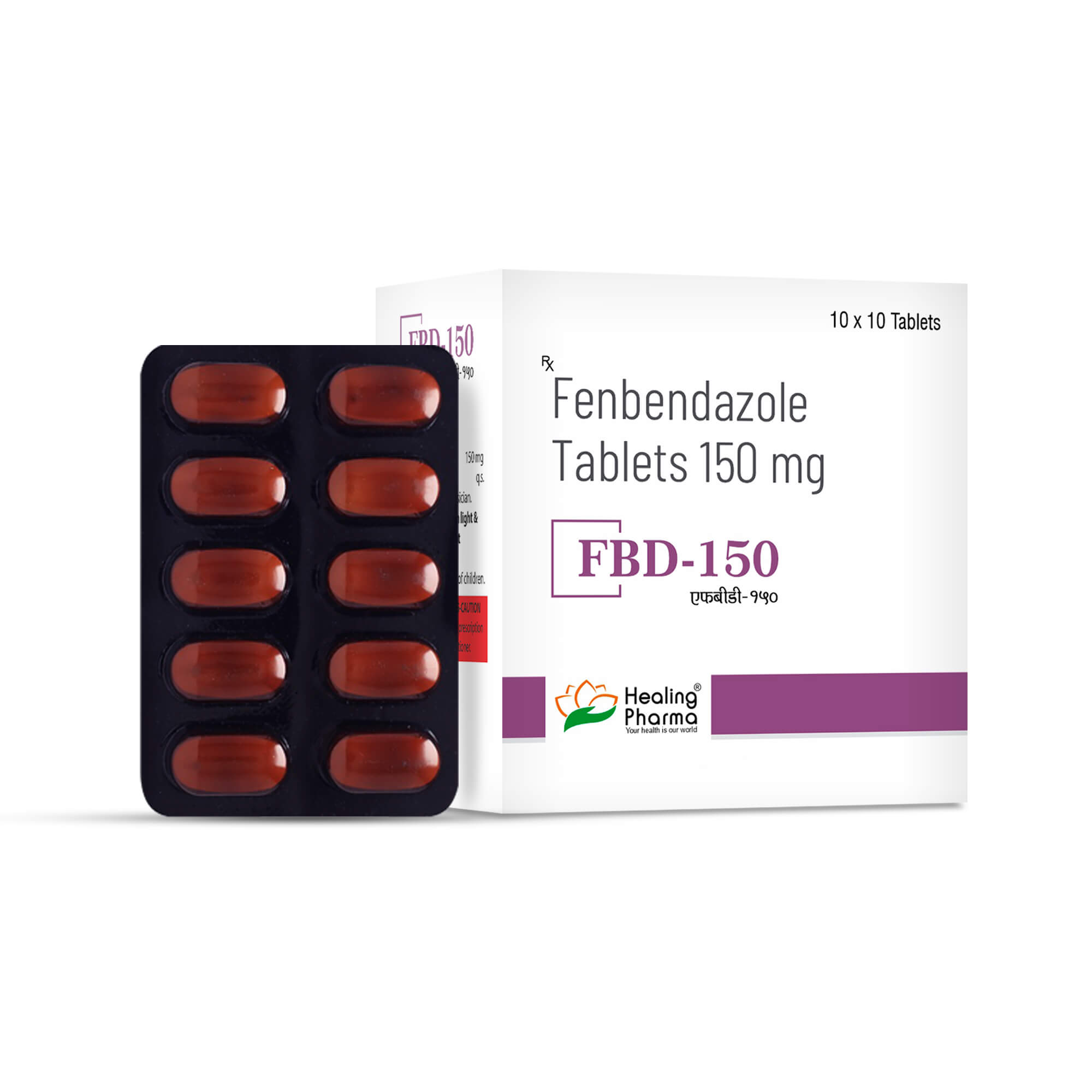
| Generic Name: | Fenbendazole Tablets |
| US Brand Name: | Panacur, Safe-Guard |
| Manufacturer Name: | Healing Pharma |
| Form: | Tablets |
| Packaging: | 10 tablets in 1 strip |
| Strength: | 150mg |
| Delivery-Time: | 6 To 15 days |
How Fenbendazole FBD 150mg May Support Cancer Research
As of recent studies, research into Fenbendazole, especially the Buy Fenbendazole 150 mg form (FBD 150 mg), for the treatment of cancer in humans is still in its early stages. The majority of the study has been conducted in laboratory or on animals; large-scale, well monitored human trials have not yet been conducted.
In 2025, one small report described three cancer patients (with breast, prostate, and skin cancer) who took Fenbendazole on their own, around 150–222 mg per day. Two of them showed signs of tumor control or shrinkage, but it’s unclear if this was due to Fenbendazole, since they were also using other treatments.
The effects of Fenbendazole are still being investigated in recent lab experiments. According to a July 2025 study, Fenbendazole helped cancer cells die more readily, which decreased the growth of lung tumors in mice by almost 60% when paired with another drug (DADA). According to a different study, Fenbendazole may also destroy breast cancer cells by inhibiting HK2, a crucial enzyme that produces energy. However, there is currently little data on human safety.
According to one review, Fenbendazole at 150 mg is generally safe, though there may be occasional liver issues. According to experts, personal success stories, such as the Joe Tippens case, are not reliable scientific evidence. In fact, one study on animals even discovered that using Fenbendazole accelerated the formation of tumors.
All things considered, Fenbendazole appears to be a promising low-cost medication that may be used to treat cancer, but adequate human testing is still required to determine whether it is effective.
Introduction to Fenbendazole and Its Conventional Use
Fenbendazole is a benzimidazole medication first developed in the 1970s to treat intestinal parasites in animals, such as worms. The U.S. FDA has not approved its use for treating anyhuman disease, including cancer, and its application in humans remains experimental and unapproved.
A related drug, mebendazole, is already authorized for use in humans to treat parasitic infections and is currently being studied for its potential anticancer properties.
Interest in Fenbendazole as a possible cancer treatment began around 2018, after a few patients claimed that it helped them recover from advanced cancer. One widely known case is that of Joe Tippens, who reported taking about 222 mg of Fenbendazole along with vitamins and CBD oil, crediting this combination for his cancer remission. His story drew widespread public attention and inspired further curiosity about the drug.
The FBD 150 mg version usually refers to a powder or capsule form of Fenbendazole sold for animals, which some people have taken themselves at doses of 150 mg three times a week to copy pet dosing schedules and reduce side effects.
Fenbendazole is of interest to researchers mainly due to its low cost, oral administration, and partial absorption by the body (20–30% after swallowing, reaching peak levels after 4–6 hours).
However, scientists urge caution, as the drug’s safety, possible side effects, and interactions with other medications in humans are not yet well understood, and its anticancer effects remain unproven. For now, FBD 150 mg serves primarily as a starting point for research, bridging what is known from veterinary use to potential future studies in humans.
Mechanisms of Action in Cancer Cells
According to lab research, Fenbendazole, at doses of about 150 mg, attacks cancer cells in a number of ways mostly by interfering with their energy supply and structure.
Fenbendazole first attaches itself to beta-tubulin, a protein that is necessary for the formation of microtubules, which are small structures that aid in cell division. The breakdown of these microtubules prevents the cancer cells from completing cell division, which causes them to become trapped in a specific stage of the cell cycle (called the G2/M phase) and ultimately die.
Additionally, Fenbendazole aids in the activation of p53, a naturally occurring tumor-suppressing protein that either repairs damaged DNA or causes abnormal cells to die. This is significant since p53-deactivating mutations are present in around half of all malignancies.
Regarding metabolism, Fenbendazole inhibits hexokinase 2 (HK2) and glucose transporters (GLUT1), which are essential components of the Warburg effect, which is how cancer cells usesugar as fuel. Fenbendazole hinders the survival of cancer cells by severing their energy source. According to lab experiments, doses between 10 and 50 μM decreased the lifespan of breast and colon cancer cells by 40–70%.
Additionally, according to more recent research, Fenbendazole may cause specific forms of cell death known as ferroptosis (death brought on by damage to cell lipids) and pyroptosis (cell bursting through inflammation).
Overall, Fenbendazole seems to target several cancer cell vulnerabilities, which could make it a versatile anti-cancer drug. However, as the majority of the data currently available comes from lab and animal studies rather than clinical trials, researchers still need to determine the appropriate safe and effective dosage for humans.
Preclinical Studies in Laboratory Settings
Early laboratory studies on Fenbendazole have demonstrated anti-tumor effects in a number of human cancer models at doses comparable to roughly 150 mg in humans (which reach blood levels of 1–10 μM). At concentrations ranging from 1 to 5 μM, fenbendazole inhibited the growth of cervical, colorectal, lung, and breast cancer cells by 50–80% in in vitro cell experiments. It primarily functioned by activating the p53 tumor-suppressor gene, which aids in cell death, and by dissolving microtubules, which are necessary for cancer cells to divide.
According to a 2024 study published in BMC Cancer, fenbendazole reduced the activity of genes related to sugar metabolism (glycolysis) and produced dose-dependent cell death in ovarian cancer cells.
In animal studies (in vivo), mice implanted with prostate or lung cancers and given 50 mg/kg of Fenbendazole (about the same as 150 mg in humans) demonstrated a 40–60% decrease in tumor size without experiencing significant adverse effects. Using nanoparticle-encapsulated Fenbendazole—a form designed to dissolve better—further improved results, shrinking ovarian tumors in mice by about 70%.
However, not every study was successful. The effects of Fenbendazole may vary depending on the kind of cancer, as seen by a 2025 review that found quicker tumor growth in a pancreatic cancer model and a 2013 study that found no benefit in some solid tumors.
With everything considered, these laboratory and animal findings provide encouraging preliminary evidence that fenbendazole may aid in slowing the growth of cancer. However, it is still in the preclinical stage, this additional study and human testing are required to verify its efficacy and safety.
Potential Synergy with Conventional Cancer Treatments
According to lab research, Fenbendazole at doses of about 150 mg may increase the effectiveness of conventional cancer treatments by decreasing drug resistance and promoting cancer cell death. Even at 1 μM, Fenbendazole helped colorectal cancer cells that were resistant to 5-fluorouracil (5-FU) regain their sensitivity to 5-FU. It caused apoptosis (programmed cell death) without endangering healthy cells and reduced the drug’s necessary dosage by around 50%.
Based on a 2025 study, when Fenbendazole and diisopropylamine dichloroacetate (DADA) were administered together, the tumor growth in lung cancer mice decreased by 60% as opposed to 30% when each medication was administered alone. A combination of immune system activation and metabolic disturbance led to this result.
Since both Fenbendazole and taxane medications like paclitaxel impact microtubules (structures involved in cell division), they also seem to perform effectively together. This would make it possible to use paclitaxel at lower dosages, which would lessen adverse effects like nerve damage.
Fenbendazole and enzalutamide, a hormone medication, together prevented 70% of resistant cancer cells from growing in prostate cancer models. This was mostly due to the p53 tumor-suppressor protein being reactivated.
According to certain human case reports, individuals who received fenbendazole in addition to chemotherapy had stable illness; however, these have not been scientifically confirmed. There hasn’t been any research done on potential drug interactions, like those with liver enzymes (CYP450). Although preliminary data suggests that fenbendazole is a promising supplement to current therapies, clinical trials are required to ensure safety and prevent adverse combinations, such as the instance in which combining Fenbendazole with ivermectin had no anti-cancer impact.
Overall, Fenbendazole 150mg Online may have potential as a supportive or combination therapy in future cancer research.
Ongoing Clinical Trials and Research Efforts
There are currently no phase II or phase III clinical trials evaluating the effectiveness of Fenbendazole 150 mg in treating human malignancies. The majority of the study to date has been restricted to case studies and phase I (early) ideas. Three individuals with advancedmalignancies, two of whom had breast and prostate cancer, self-administered roughly 150 mg of fenbendazole. Researchers called for additional formal and well-controlled investigations after two of them displayed partial tumor responses.
The Euclid Initiative endorsed clinical trials in June 2025, citing fenbendazole’s high tolerability in laboratory and animal tests. However, because Fenbendazole is still formally categorized as a veterinary medication, regulatory obstacles are preventing advancement from happening quickly.
Some observational studies are tracking off-label use through databases, which monitor patients taking 150–444 mg weekly. According to preliminary data, there have been no severe adverse responses thus far, only mild stomach-related side effects. In order to inform future cancer dosing techniques, a multicenter trial in South Korea is also investigating the pharmacokinetics of Fenbendazole using 20 healthy volunteers in 2024–2025.
International drug-repurposing initiatives, are investigating benzimidazole-based molecules, such as Fenbendazole, and it is anticipated that pancreatic cancer trials will start in early 2026.
Experts continue to emphasize the necessity for morally sound, meticulously planned human trials to verify Fenbendazole’s safety and stop the dissemination of false information about untested cancer treatments, despite the fact that recent publications have raised scientific interest in the drug.
Future Directions and Research Gaps
Phase I and II clinical trials should be the main focus of future research on Fenbendazole 150 mg in order to ascertain its efficacy, safety, and appropriate dosage in people, particularly for colorectal and breast cancers, where laboratory studies have shown the greatest promise.
Numerous important research gaps still exist. Long-term adverse effects, such as potential liver damage from prolonged use, are still unclear to scientists. Enhancing bioavailability—the body’s ability to absorb Fenbendazole—using formulations based on nanoparticles may also increase the efficacy of treatment. In order to forecast which patients are most likely to respond, researchers must also find biomarkers.
In order to overcome medication resistance, which has not yet been investigated in people, future trials may investigate combinations with immunotherapy or tyrosine kinase inhibitors (TKIs).
Simplifying regulatory frameworks is also necessary to facilitate the repurposing of Fenbendazole for human use, as the existing veterinary sourcing raises questions regarding thequality and purity of the medicine. Furthermore, studies frequently underrepresent individuals with other conditions and older persons, which may produce biased or insufficient data.
According to a 2025 review, AI-based modeling has the potential to assist close the gap between laboratory research and clinical practice by predicting how Fenbendazole may interact with other medications. Future studies that verify its efficacy and safety could make Fenbendazole 150mg Medicine a cost-effective cancer treatment option, which would be particularly beneficial in nations with limited resources. But utilizing Fenbendazole without a doctor’s supervision could put established treatments at risk and delay them until adequate trials are completed.
In order to close these gaps and progress Fenbendazole research by 2030, international research partnerships and financial support are desperately needed.
FAQS?
Is Fenbendazole FDA-approved for cancer treatment?
No, Fenbendazole is not FDA-approved for cancer treatment in humans.
What is the typical dosage used in studies?
Anecdotal and preclinical human dosages vary from 150–444 mg three times a week or daily.
Can Fenbendazole be used alongside conventional cancer treatments?
Although human safety has not been established, preclinical data points to synergy with therapies like 5-FU or taxanes.
What side effects are associated with Fenbendazole?
There have been reports of mild gastrointestinal problems and uncommon increases of liver enzymes, but no long-term consequences are known.
What does the future hold for Fenbendazole in cancer therapy?
To confirm effectiveness, optimize dosage, and guarantee human safety, phase I/II trials are required.
Other Medicine:- Ziverdo Kit | Azipro 250mg | Azipro 500mg | HCQS 200mg | HCQS 400mg